

On April 28, 2025, the Seminar on Money Laundering Risk Assessment, hosted by the Law School of Beijing Normal University, convened in the second-floor lecture hall of the Yingdong Academic Hall. This event marked the inaugural seminar organized by the Law School's newly established Anti-Money Laundering Research Center. Over eighty attendees gathered for the occasion, including representatives from the Anti-Money Laundering Bureau of the People's Bank of China, the Economic Crime Prosecution Department of the Supreme People's Procuratorate, and various provincial branches of the People's Bank of China. Key personnel from major financial institutions, alongside scholars and experts from universities and research institutes, engaged in in-depth discussions on national-level money laundering risk assessments.
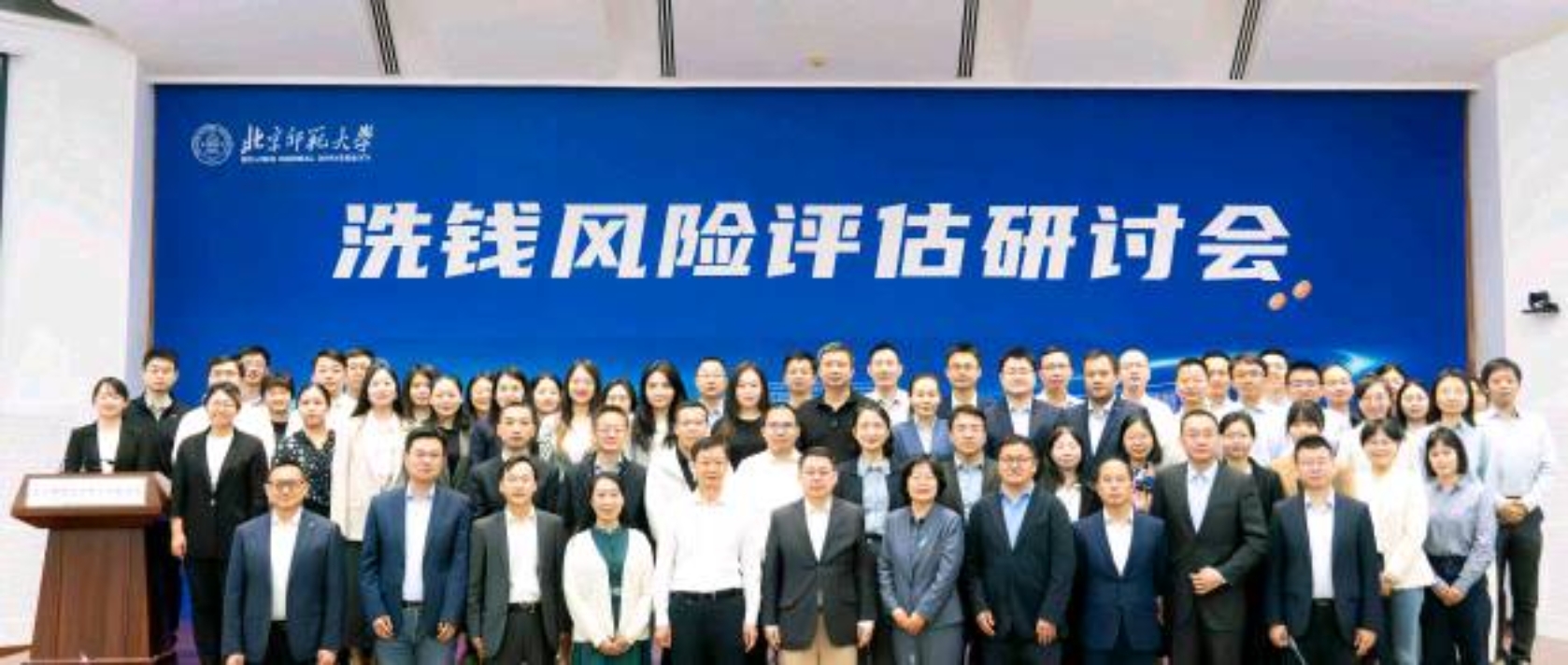
Group Photo
Professor Chai Rong, Secretary of the Party Committee of the Law School, delivered a welcoming address on behalf of the institution. She highlighted that with the evolution of the global economy and advancements in digital technology, money laundering activities have grown increasingly concealed, complex, and cross-border. These developments pose significant risks to national financial security, social stability, and the safety of citizens' assets, presenting new challenges for financial regulation and the criminal justice system. Professor Chai noted that the seminar focused on key, difficult, and cutting-edge issues within the current anti-money laundering legal framework. By aligning with national strategic needs and international financial cooperation trends, she expressed confidence that the dialogue between academia and practitioners would inject new momentum into the improvement of China's money laundering risk assessment reports and legal systems.
Director Bao Mingyou of the Anti-Money Laundering Bureau of the People's Bank of China commended the Law School for its contributions to the nation's anti-money laundering legal framework. He emphasized the critical significance of national-level risk assessments, identifying a "risk-based" approach as the core principle of anti-money laundering and counter-terrorism financing systems. As the foundational step in this process, risk assessment directly guides the formulation and implementation of policy. Director Bao stressed that assessments must rely on quantitative data while integrating academic perspectives and the practical experience of financial institutions. This multi-dimensional approach ensures that evaluation reports accurately and comprehensively reflect the actual landscape of money laundering risks in China.
The seminar featured six thematic sessions. The first session, chaired by Ye Qingguo from the Anti-Money Laundering Bureau, addressed "Money Laundering Threats Facing China." Speakers included Professor Wang Xin from Peking University Law School, Professor Zhang Lei from Beijing Normal University Law School, and representatives from the Agricultural Bank of China and CITIC Securities. Drawing on his practical experience at the Supreme People's Procuratorate, Professor Wang provided an in-depth overview of financial crime review practices. The second session, chaired by Tuo Yang from the Bureau's Regulatory Division, focused on "Deficiencies in Anti-Money Laundering in the Financial Industry," featuring insights from Professor Jia Jidong and Associate Professor Yang Chao of Beijing Normal University, alongside representatives from China Merchants Bank and Galaxy Securities.
The third session, themed "Money Laundering Risks in Specific Areas," was chaired by Professor Yuan Zhijie, Director of the Anti-Money Laundering Research Center. Beijing Jin, Deputy Director of the Economic Crime Prosecution Office of the Supreme People's Procuratorate, introduced relevant prosecutorial work, urging academia to strengthen research on targeted legal issues arising from new cases and to actively participate in international anti-money laundering governance. Professor Yin Bo from the China University of Political Science and Law and representatives from the Bank of China also contributed to the discussion. Session Four, chaired by Wu Yun from the Anti-Money Laundering Bureau, explored "Money Laundering Risks of Legal Persons and Legal Arrangements" with Professor Yuan Zhijie, Associate Professor Shang Haowen, and representatives from Nanjing Bank. Session Five, chaired by Professor Jia Jidong, examined "Terrorist Financing Risks," featuring speakers from the People's Bank of China's Xinjiang branch, Yunnan University, the China University of Political Science and Law, and the Agricultural Bank. The final session, chaired by Xu Qipeng from the Bureau's Evaluation Department, discussed "Proliferation Financing Risks" with researchers from the Ministry of Commerce and the China Institute of Contemporary International Relations, as well as representatives from the life insurance sector.
This seminar established a valuable platform for communication between anti-money laundering theorists and practitioners, effectively fostering cooperation and exchange. The Law School anticipates that the establishment of the Anti-Money Laundering Research Center will further integrate academic resources, contributing high-level research outcomes to the advancement of China's anti-money laundering endeavors.