

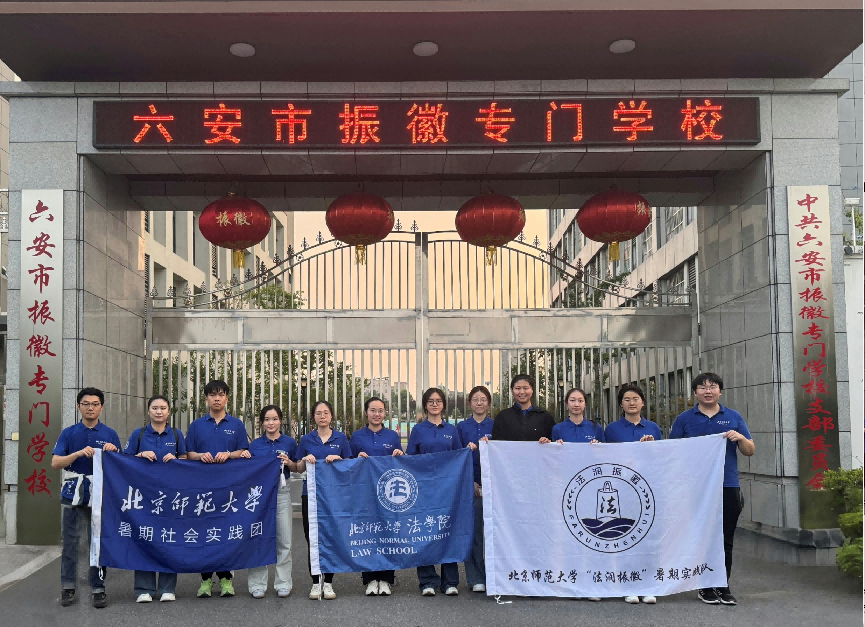
(Faculty and students from the Law School of Beijing Normal University at Zhenhui Special Education School in Lu’an, Anhui Province, photo by Li Xinzi)
Recently, faculty and students from the Law School of Beijing Normal University (BNU) completed a two-week teaching support program at the Zhenhui Special Education School in Lu'an, Anhui Province. The team implemented a five-dimensional curriculum focusing on legal practice, mental health, basic culture, artistic literacy, and quality development. By integrating the awareness of rules into daily teaching, the program aimed to help misguided youth reshape their life ideals.
The "Legal Enlightenment at Zhenhui" project, organized by the BNU Youth League Committee and guided by the Law School, was selected as part of the Communist Youth League Central Committee's "Legal China Youth Action" 2025 summer social practice initiative. The fifteen-member team comprised graduate and doctoral students from six disciplines: Law, Education, Psychology, Physical Education and Sports, Arts and Communication, and Foreign Languages and Literature.
Strengthening the prevention and governance of juvenile delinquency is a societal imperative. Special education schools, which serve minors with serious behavioral issues, currently face significant challenges, including weak cultural education, imbalanced curricula, and insufficient social support. These gaps often hinder the effective implementation of graded intervention strategies for juvenile offenders.
Upholding a strong sense of social responsibility, BNU leveraged its interdisciplinary strengths to deploy this professional team to Lu'an. The initiative sought to balance behavior correction with legal enlightenment, and psychological counseling with value reconstruction, to address these systemic educational challenges.
The team designed a comprehensive curriculum where simulation-based legal education allowed students to experience judicial procedures firsthand, immersing them in the consequences of illegal activities. Innovative, interdisciplinary models—such as "English + History" and "Psychology + Art"—were employed to broaden horizons and enhance engagement. Furthermore, values were integrated into courses on psychology, poetry, and sports to awaken minds through cognitive training, guide actions through artistic practice, and forge spirits through athletics. The team also established parent classes to guide families in understanding parent-child dynamics and adjusting communication methods. By utilizing their diverse strengths, team members allowed the concepts of the rule of law, healthy personality, and patriotism to nurture the hearts of every wayward youth.
This initiative successfully updated parental educational concepts, activated home-school co-education mechanisms, and promoted the development of specialized teaching materials. It contributed to tangible improvements in the behavior of juvenile offenders. The core outcomes, including the course system design and graded correction plans, represent a high degree of integration between theory and practice, offering a replicable blueprint for similar institutions.
In this practical lesson on "Rule of Law + Education," BNU youth vividly embodied the university motto, "Learn, so as to instruct others. Act, to serve as example to all." They illuminated the path for wayward youth with the light of the law, providing practical experience and exploring long-term mechanisms for improving juvenile education and correction.
(By Zhang Xinyi, Zhang Jie, Cheng Zhaojin)