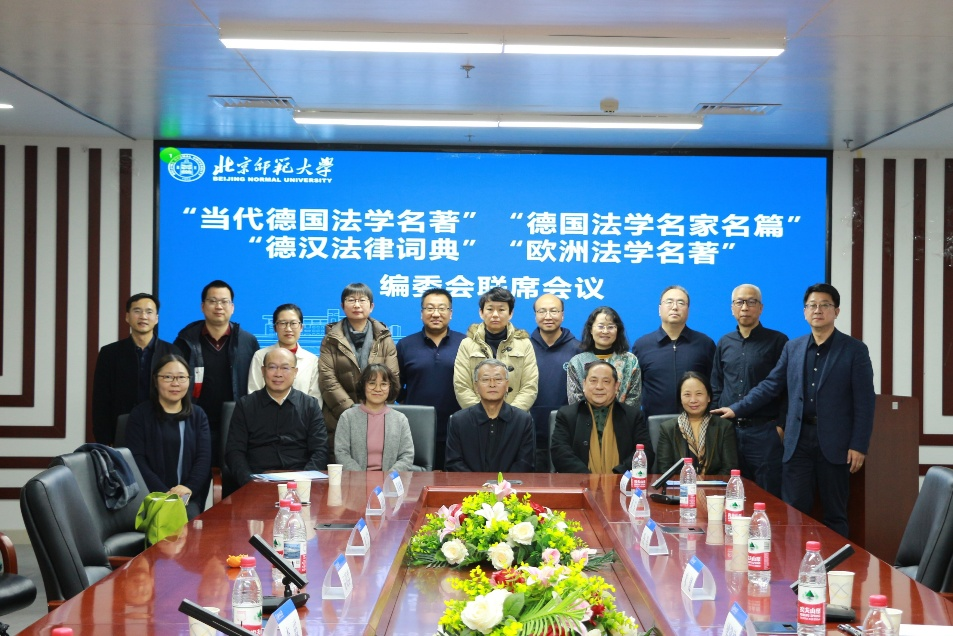
On the afternoon of February 26, 2026, a joint meeting of the editorial boards for "Contemporary German Legal Classics" "Masterpieces by German Legal Scholars" "German-Chinese Legal Dictionary" and "European Legal Classics" was held at the Gao Mingxuan Academic Lecture Hall of the School of Law at Beijing Normal University. Scholars from Peking University, Tsinghua University, China University of Political Science and Law, Renmin University of China, Central University of Finance and Economics and other institutions, along with colleagues from the Commercial Press, China Law Press and other organizations, gathered to discuss these legal translation projects.
During the opening ceremony, Professor Liang Yingxiu, Dean of the School of Law at Beijing Normal University, delivered a welcome address. He provided a systematic overview of the development of the legal discipline at Beijing Normal University and stated that the School of Law places great emphasis on academic translation and will continue to provide all possible support for the translation projects in the future.
Li Xia, Deputy Editor-in-Chief of the Commercial Press, then delivered a speech. She noted that the existing "Contemporary German Legal Classics" and "Masterpieces by German Legal Scholars" series aim to present the essence of Germany’s rule of law system and the core of its legal thought, while the "German-Chinese Legal Dictionary" serves as a foundational project for "standardizing legal terminology" in the legal field, thereby supporting the first two initiatives. Currently, the Commercial Press plans to expand its scope to continental Europe, using the translation of renowned European legal works as a starting point to promote the development of a more comprehensive framework for comparative law research between China and the West. The Commercial Press will also collaborate with the project’s editorial board to comprehensively advance the "German-Chinese Legal Dictionary" and "European Legal Classics" projects while consolidating existing initiatives.
Following the opening remarks, Mr. Mi Jian, Distinguished Professor at Beijing Normal University, outlined the background, objectives, and content of the joint conference. He noted that the translation of legal works—particularly textbooks—has had a profound impact on the development of Chinese jurisprudence. The "Contemporary German Legal Classics" series systematically introduces and disseminates the general theoretical doctrines of the civil law system, while the "Masterpieces by German Legal Scholars" series strives to go a step further by elevating the discourse from institutional rules to the level of values and ideas, thereby enriching legal thought. The "German-Chinese Legal Dictionary" is dedicated to standardizing legal terminology, achieving the unification and standardization of legal concepts through the compilation of the dictionary. Meanwhile, the "European Legal Classics" project aims to broaden horizons and expand scope—standing taller, seeing farther, and looking toward the future—to lay the groundwork at the legal level for China’s integration into the world and the building of a community with a shared future for mankind. These four projects are advancing in stages, progressing from legal and cultural exchange to a phase of mutual learning and joint construction among civilizations. Professor Mi Jian expressed the hope that by 2028—the 30th anniversary of the launch of the "Contemporary German Legal Classics" project—the publication of all 50 works in the series will be successfully completed. Concurrently, efforts will be made to publish more "Masterpieces by Eminent Scholars" as planned, as well as the "German-Chinese Legal Dictionary" and the first batch of titles in the "European Legal Classics" series.
The successful convening of this joint meeting has comprehensively mapped out the progress of legal translation and compilation projects, systematically summarized years of practical experience and valuable achievements, and further clarified the future development path and key priorities for translation. Taking this meeting as a new starting point, the Editorial Board will continue to uphold its founding principles of diligence, practicality, and a commitment to excellence in scholarship and publishing. Through more systematic planning, stricter standards, and closer collaboration, it will continue to deepen the translation and introduction of Sino-European legal classics and the standardization of legal concepts, thereby continuously promoting the high-quality development of legal translation.
Moving forward, the School of Law at Beijing Normal University will establish an editorial office for the "European Legal Classics" translation project to fully advance its implementation. We kindly invite the attention and support of our colleagues in the academic community.