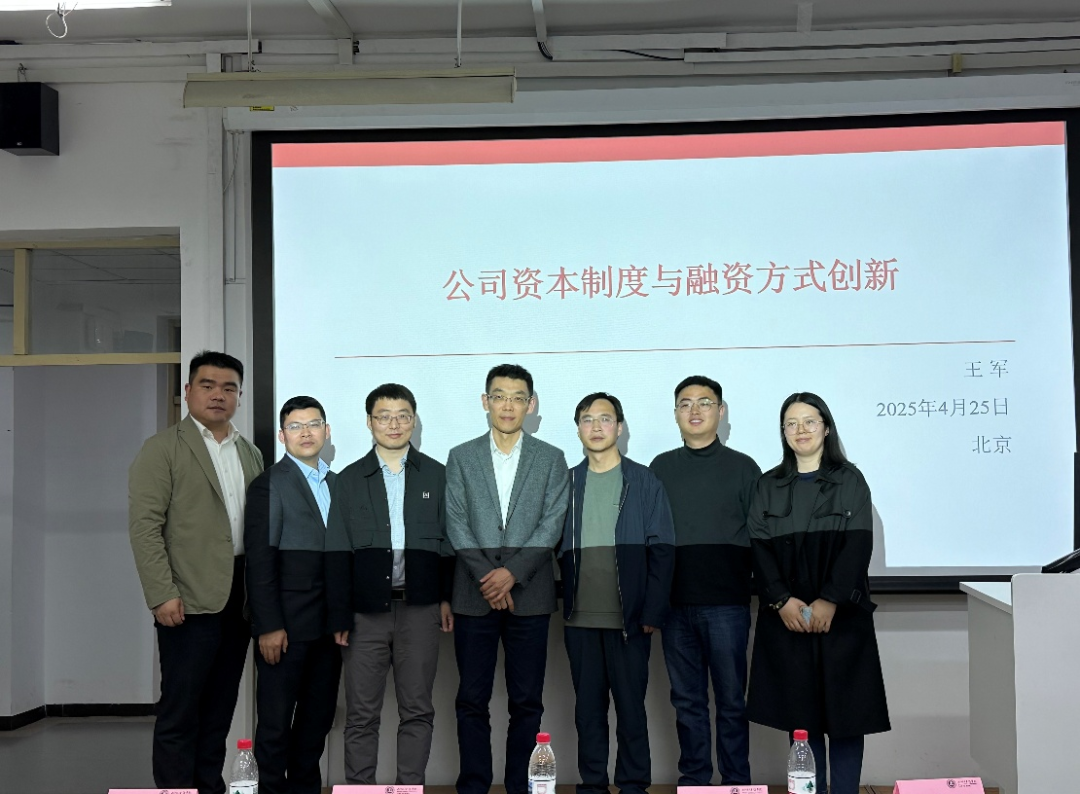
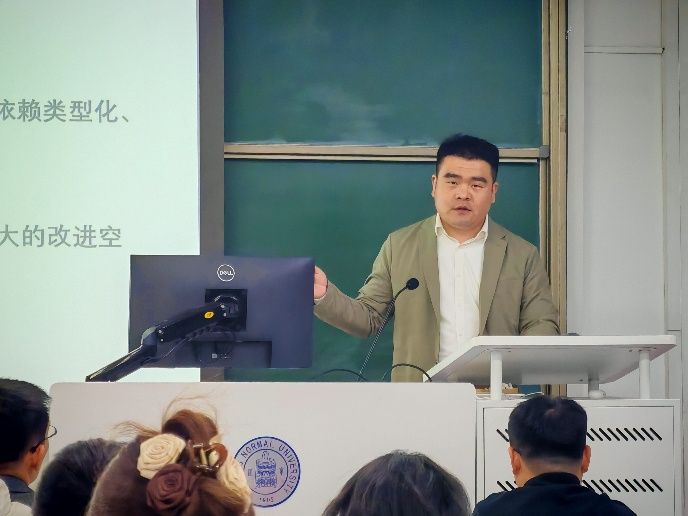
On the evening of April 25, 2025, at 7 PM, the 44th lecture in the BNU Law Lecture Series, entitled "Innovation in Corporate Capital System and Financing Methods," was successfully held in Room 201 of the Second Teaching Building at Beijing Normal University. This lecture was delivered by Professor Wang Jun, the Deputy Director of the Institute of Company Law and Investment Protection at China University of Political Science and Law, and was hosted by Professor Yuan Zhijie, the Vice Dean of the Law School at Beijing Normal University. Serving as panelists were Professor Liu Donghui from the School of Civil and Commercial Economic Law at China University of Political Science and Law, Professor Xiao Xin from the Institute of Law at the Chinese Academy of Social Sciences, Lawyer Ma Shaojie from Baichen Law Firm, and Professors Ai Huizi and Sun Xinkuan from the Law School at Beijing Normal University. Nearly a hundred students attended this lecture.
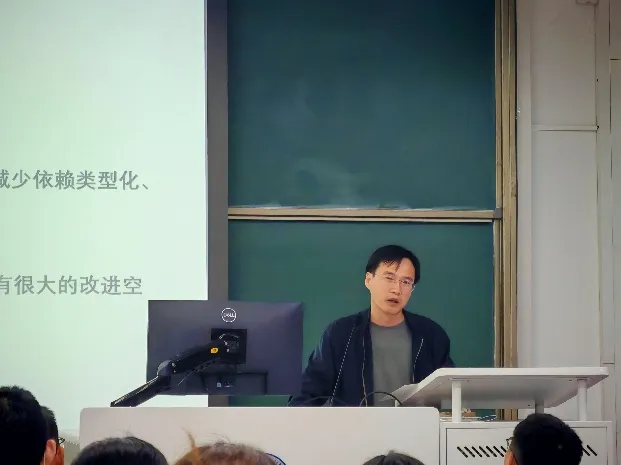
Professor Yuan Zhijie began by introducing Professor Wang Jun, emphasizing his significant research achievements in the field of company law. He noted that Professor Wang's published works, such as "Corporate Capital System" and "Chinese Company Law," have had a profound impact in academia, and extended a warm welcome and sincere gratitude for Professor Wang's visit to Beijing Normal University.

During the thematic lecture segment, Professor Wang Jun briefly analyzed the basic framework of capital formation and capital repayment regulations in China's company law. Regarding the capital formation system, the 2023 revision of the company law strengthened the obligation for shareholders to make actual contributions, aiming to ensure that shareholders provide genuine capital during the company's capital formation phase to enhance the company's debt repayment capacity. However, a company's ability to repay debts depends on its current and future cash flows rather than the capital formed by shareholder contributions. In fact, a company's paid-in capital or equity does not have a direct or obvious role in maintaining the company's debt repayment capacity. Excessive emphasis in company legislation on the role of capital formation in a company's debt repayment capacity may impose undue restrictions on investment and financing, which is detrimental to encouraging investment and facilitating financing. Regarding the capital maintenance system, Professor Wang Jun enumerated and explained the relevant rules for maintaining company capital as stipulated in company law, such as the prohibition of capital withdrawal, profit distribution, share buybacks, and reduction of registered capital. He pointed out the contradiction between the static nature of the capital maintenance principle and the dynamic nature of corporate cash flow, noting that the current capital maintenance rules have not received sufficient attention regarding their relationship with the company's debt repayment ability, which is disconnected from the bankruptcy standards set forth in corporate bankruptcy law.
In the second part, Professor Wang Jun further discussed the recent practices and innovations in corporate financing. He pointed out that contracts are the main tool for innovating financing methods, and companies primarily construct various hybrid equity-debt and equity-debt conversion financing methods through contracts to optimize capital structure and enhance financing efficiency. Next, he focused on elaborating the two financing methods: the bet agreement and revenue-sharing financing.
Regarding Valuation Adjustment Mechanisms (VAM), Professor Wang Jun argues that the Minutes of the Ninth National Courts' Civil and Commercial Trial Work Conference (the "Ninth Minutes") is not entirely accurate in characterizing them strictly as "valuation adjustment agreements." Chinese enterprises were first introduced to VAMs during the influx of foreign private equity investment in the 1990s. Early iterations of these agreements, such as Warburg Pincus's investment in AsiaInfo in 1996 and Mengniu's offshore financing in 2002, adjusted the investor's equity stake and class based on fluctuations in the target company's valuation. However, the VAMs prevalent in China's private investment sector in recent years utilize performance compensation or equity buybacks as adjustment tools. When VAM conditions are triggered, the investor effectively converts their equity into debt, which marks a substantive departure from early valuation adjustments. Furthermore, Professor Wang provided a detailed analysis of the exercise period and nature of the investor's buyback right (put option). He posits that determining whether such a right constitutes a right of formation or a right of claim, and whether it is subject to a reasonable time limit, requires a case-by-case determination based on factors such as the contractual purpose, specific stipulations of the buyback clause, and the actual performance of the contract.
Regarding revenue-based financing, Professor Wang Jun used the daily revenue-sharing contract of Micro Connect as an example to elaborate on its operational mechanism and discuss its investment nature. He believes that Micro Connect obtains revenue based on store operating income rather than profit, which does not belong to equity investment, but should be a type of debt investment combined with equity attributes.
Finally, Professor Wang Jun summarized his observational opinions on the innovation of financing methods based on the above discussion: First, contracts and technological advancements play a key role in the innovation of financing methods. Second, the dichotomy between equity and debt remains an effective distinguishing criterion. Third, dispute resolution institutions should handle disputes more through case-specific contract interpretation, minimizing reliance on generalized, conceptual rules. Professor Wang Jun pointed out that the current corporate capital system in our country is still based on the company law of Europe and America from the early 20th century, and there is still significant room for improvement.

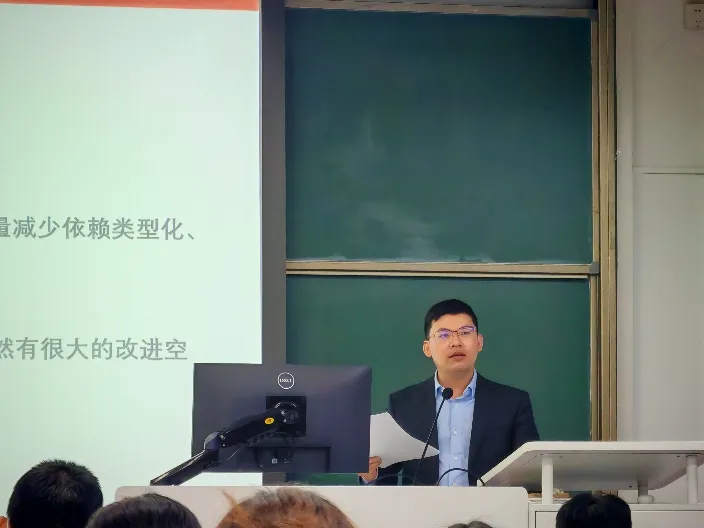
During the discussion, Professor Liu Donghui started from the close relationship between the company's capital system and financial regulatory system, as well as the relationship between financing freedom and financing control reflected in the equity-debt dichotomy. He pointed out that financing innovation cannot be separated from the institutional requirements of financial regulation by citing the information disclosure obligations of equity financing and the asset-liability ratio restrictions of debt financing.
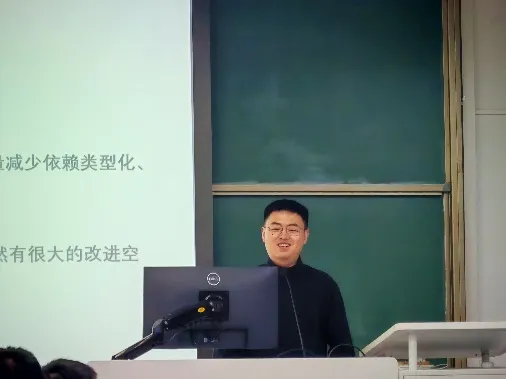
Professor Xiao Xin analyzed the nature of repurchase rights for investors in valuation adjustment agreements and bet agreements, as well as income-sharing agreements and the binary opposition view of the equity-debt dichotomy from the perspectives of functionalism and formalism. He believes that traditional civil law rules focus more on the achievement of external transactions and rule setting, which is a type of transactional law, and rarely involves the internal balance of interests between the two parties in a transaction. However, when dealing with rules such as income-sharing agreements, there will be a tension between organizational law and transactional law. Therefore, we should break away from the typified binary division rules and dynamically allocate the effectiveness of contracts through contract interpretation in individual cases.
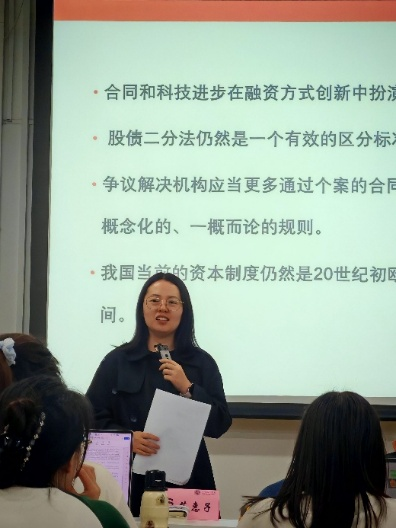
Lawyer Ma Shaojie shared his understanding of the corporate capital system based on practical cases. He first pointed out that the specific terms and interpretations in contracts are of great significance for determining the responsibilities of shareholders within the company. Secondly, by sorting out the evolution of investment terms, he pointed out that the current rules of investment terms are actually a specific product of the internet era. Investors use business models that have been successfully validated abroad to make investments, which differs from the risks associated with investing in unknown business models in the current era. Therefore, the applicable rules for liability should also be differentiated.

Ms. Ai Huizi shared her two insights from Professor Wang Jun's lecture: first, regarding the research subject, one should first train the ability to clearly sort out and articulate research questions before hastily proposing so-called “legislative suggestions” and “policy responses”. Second, when conducting research, one should strive for truth, reality, and sources like Professor Wang, deeply grasping the importance of historical context sorting and empirical analysis in writing and research.
Mr. Sun Xinkuan first expressed gratitude to Professor Wang Jun, believing that Professor Wang's analysis of the betting agreements and daily revenue-sharing contracts was profound and enlightening, deepening our understanding of corporate capital systems. The cases and interdisciplinary analytical perspectives adopted by Professor Wang have brought new inspiration to our research methods.
Finally, Vice Dean Yuan Zhijie summarized the speeches of Professor Wang Jun and the various discussants, pointing out that although our company law is a codified statute under the framework of the civil law system, it has actually absorbed flexible rules from common law systems like American law in its specific institutional design. Therefore, how to address the locally characterized corporate capital system requires further responses from legal rules and interpretations.
The lecture concluded with a dynamic Q&A session, where students actively engaged Professor Wang on complex topics, including the validity of Valuation Adjustment Mechanisms and the dichotomy between equity and debt. Professor Wang provided comprehensive responses to their inquiries, bringing the event to a successful close.