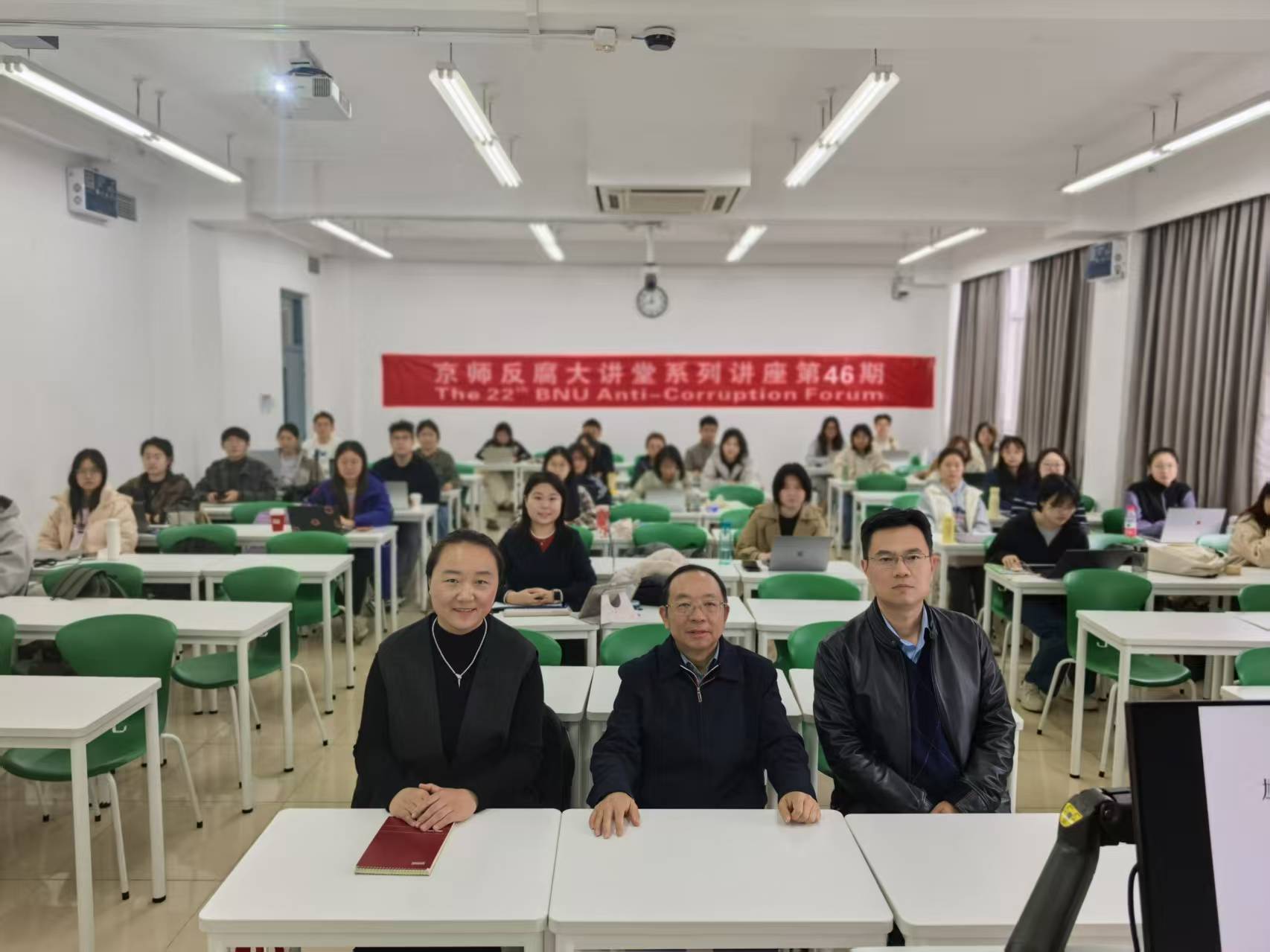
On October 29, 2025, the 46th session of the BNU Anti-corruption Lecture Series, titled "The Historical Formation and Development of International Cooperation Against Corruption," was successfully held in Classroom 404 of Teaching Building 7 at Beijing Normal University. The lecture was delivered by Chen Lei, a Second-Level Inspector at the Research Office of the Central Commission for Discipline Inspection and the National Supervisory Commission, a Discipline Inspection and Supervision Officer, a Senior Inspector, and a part-time researcher at the G20 Research Center on Cooperation Regarding Persons Sought for Corruption and Asset Recovery. The event was hosted by Zhao Chengguang, an Associate Professor at the Law School of Beijing Normal University. More than 30 faculty members and students, including Professor Zhang Lei from the BNU Law School, attended the lecture.
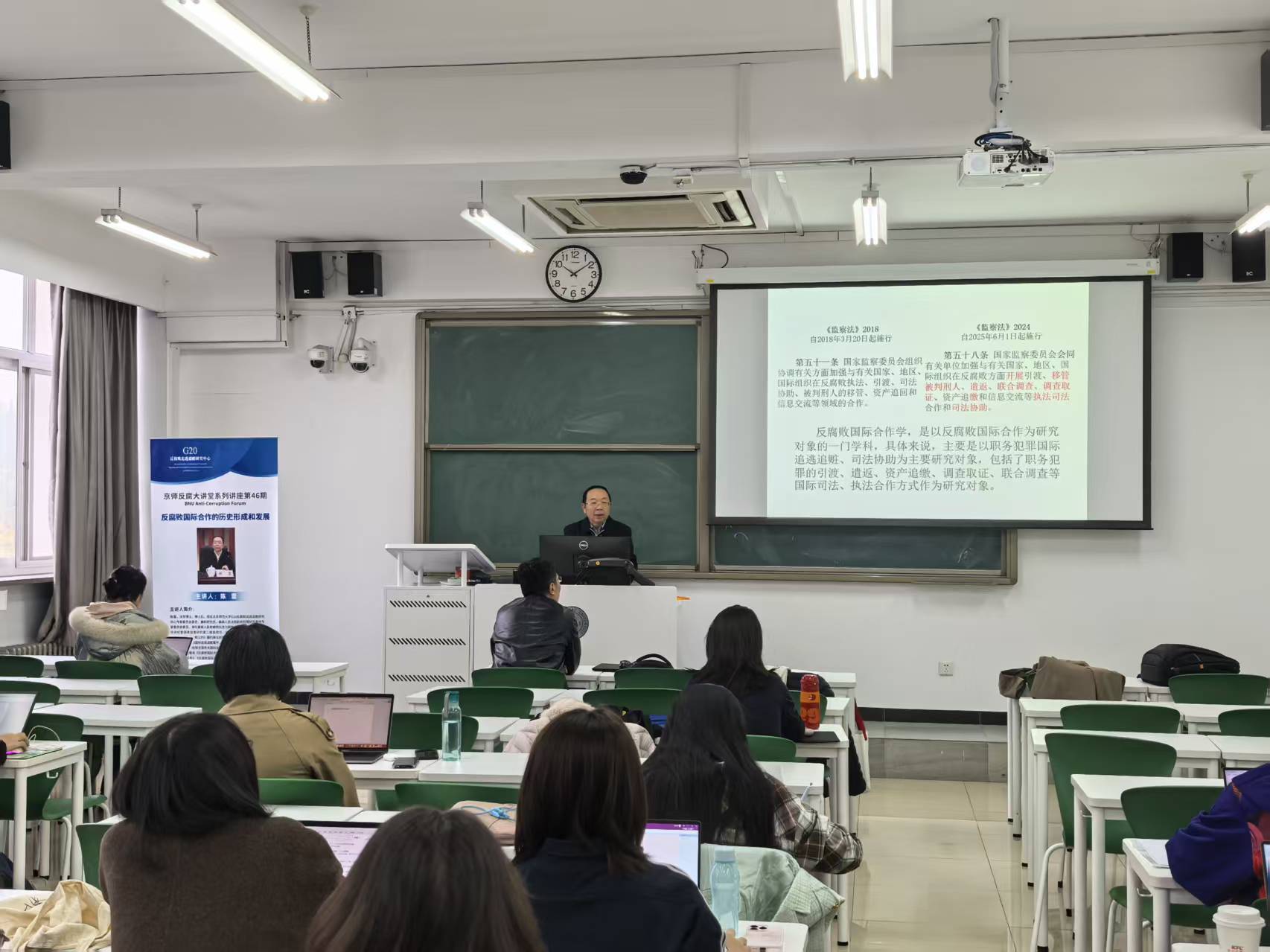
To begin, Associate Professor Zhao Chengguang expressed his heartfelt gratitude to Mr. Chen Lei for his visit and introduced the audience to his extensive professional experience, research background, and significant achievements in the field of international anti-corruption cooperation.
Mr. Chen Lei opened his lecture with a brief introduction to the study of international cooperation against corruption. He defined it as a discipline centered on collaborative anti-corruption efforts, specifically focusing on the international pursuit and asset recovery for duty-related crimes, as well as judicial assistance. This includes mechanisms such as extradition, repatriation, asset recovery, investigation and evidence collection, and joint investigations as forms of international judicial and law enforcement cooperation.
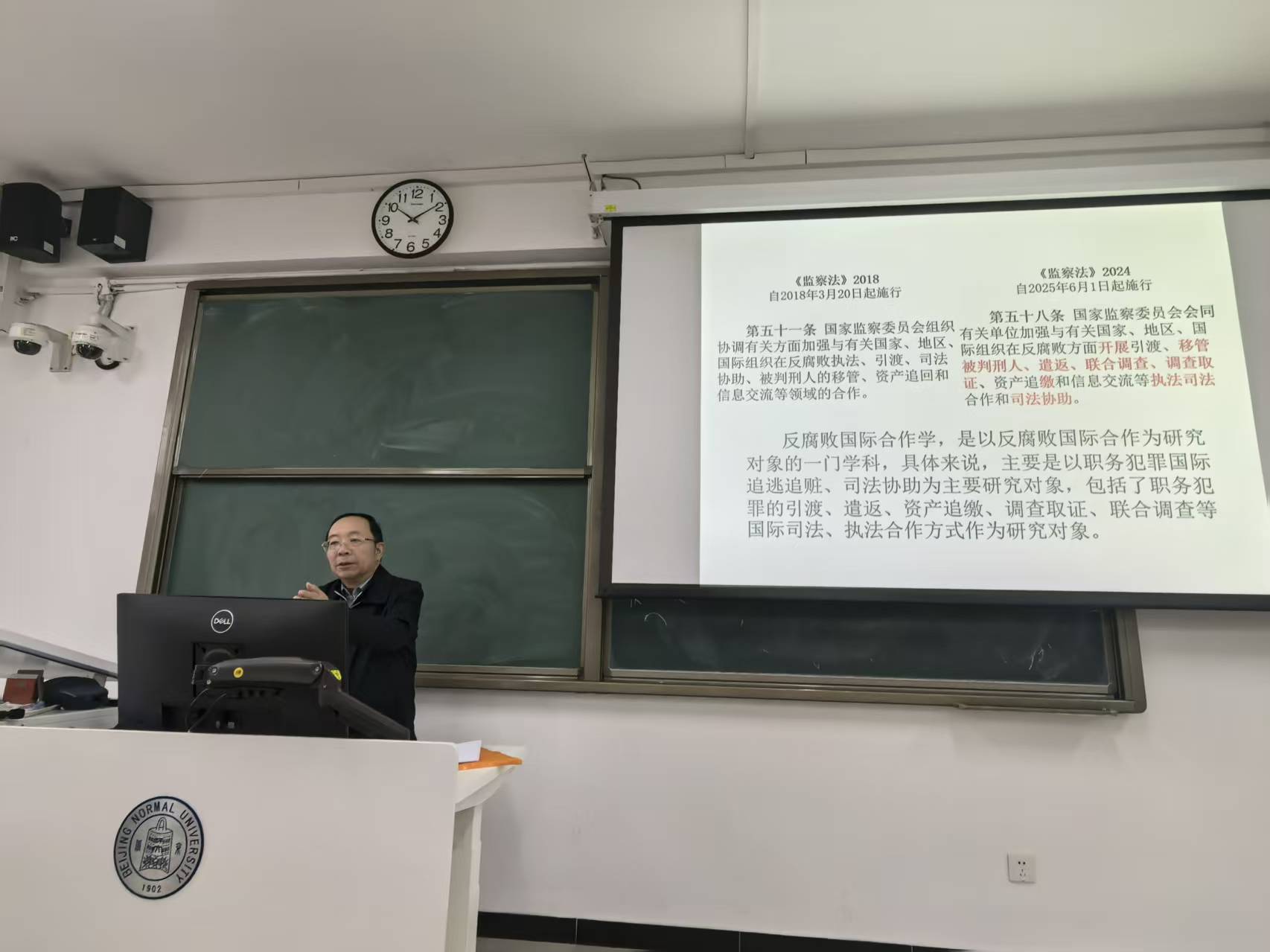
Next, Chen Lei discussed the historical formation and development of international anti-corruption cooperation from both international and domestic perspectives. Internationally, the origins of such cooperation can be traced back to the 1970s, when the Watergate and Lockheed bribery scandals shocked the global community. In response, the United Nations, regional bodies, and other international organizations adopted a series of instruments to combat corruption, such as the United Nations Declaration Against Corruption in International Commercial Transactions and the United Nations Convention Against Transnational Organized Crime. Domestically, China's international anti-corruption cooperation has evolved through three stages: initial exploration, active exploration, and gradual improvement. Chen Lei cited the extradition case of Chen Manxiong and Chen Qiuyuan to illustrate China's initial exploration. He then discussed China's active exploration of diverse methods for pursuing fugitives and recovering assets through the cases of Yuan Tongshun's mutual extradition, Lai Changxing's repatriation, the Bank of China Kaiping Branch case, and the persuasion of Yang Xiuzhu to return. Finally, using the cases of Li Huabo, Yao Jinqi, and Cheng Sanchang, he explained how China has gradually refined its international cooperation mechanisms, moving towards a path of legalization and standardization.
In his concluding remarks, Associate Professor Zhao Chengguang expressed sincere gratitude for Mr. Chen Lei's insightful presentation. The lecture ended successfully amidst warm applause from the faculty and students in attendance. Rich in content and profound in thought, the session not only deepened the audience's understanding of international anti-corruption cooperation but also inspired enthusiasm for further learning and reflection.