

On the morning of March 20, 2025, the first lecture in the "Big Data and Artificial Intelligence Law" series took place in Classroom 413 of Teaching Building 2. Professor Liu Quan from the Law School of Central University of Finance and Economics delivered an insightful and accessible academic lecture titled "Principles of Lawfulness, Justifiability, and Necessity in Personal Information Processing." The event was hosted by Professor Wang Qinghua from the Law School of Beijing Normal University.
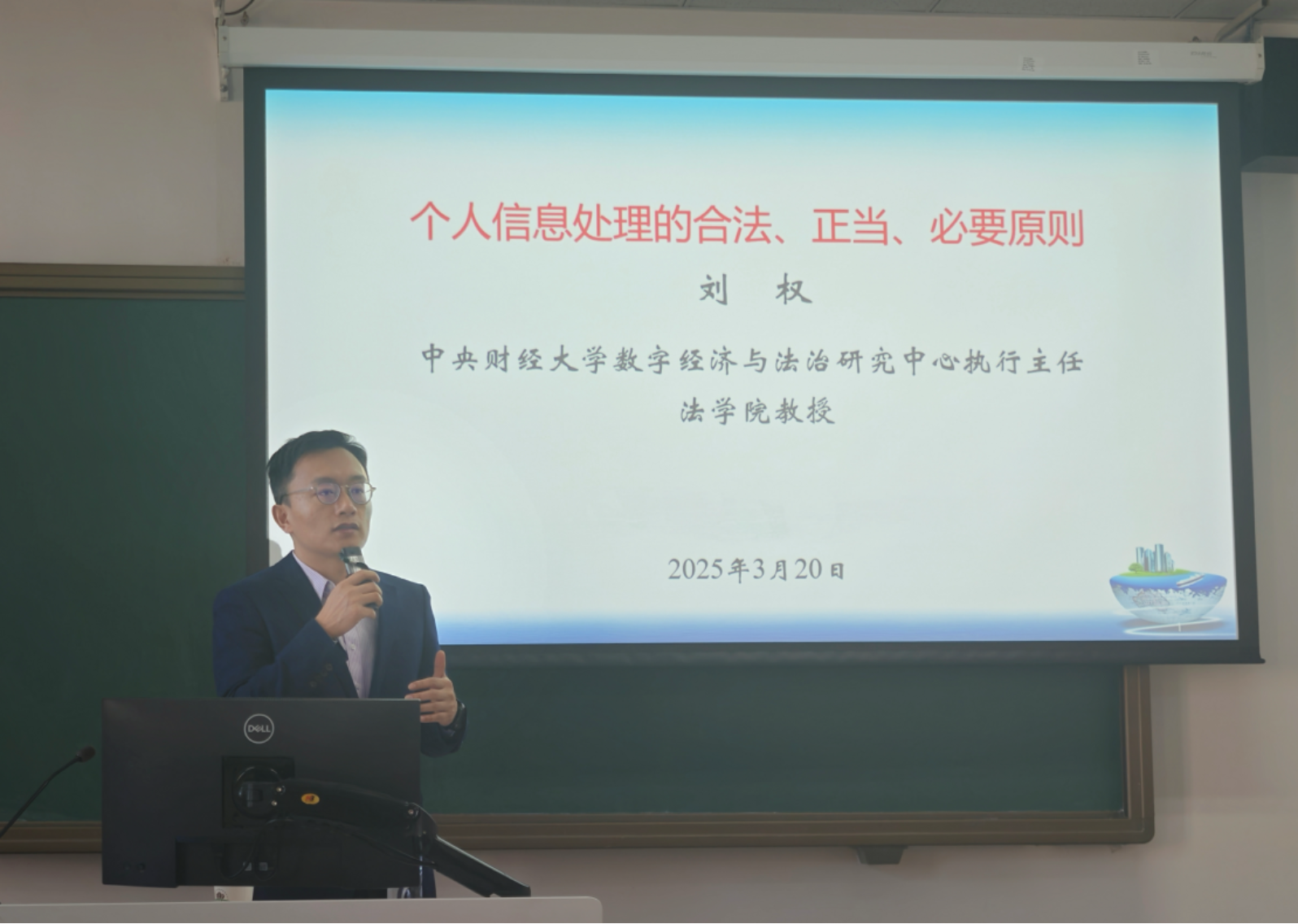
At the outset, Professor Liu observed that while there are numerous basic principles governing the processing of personal information, the principles of lawfulness, justifiability, and necessity are regarded as the "imperial principles." These serve as fundamental guidelines for enterprises and act as critical bases for administrative supervision and judicial adjudication. Their core status in the field is underscored by explicit stipulations in major Chinese legal norms, including the Cybersecurity Law, the Civil Code, and the Personal Information Protection Law.
Professor Liu analyzed the principle of lawfulness, noting that "lawfulness" entails a distinction between formal and substantive legality. Formal lawfulness refers to compliance with established legal rules, whereas substantive lawfulness requires not only adherence to these rules but also alignment with broader legal principles. The justifiable principle focuses primarily on evaluating purpose, mandating that personal information processing must have specific, clear, and reasonable objectives. These objectives must be reasonable, serving either the public interest—such as responding to public emergencies or news reporting—or private interests, such as contract fulfillment or the protection of vital personal interests.
The principle of necessity acts as a constraint on the means of processing. On one hand, processing must not exceed legitimate purposes; information collection should be limited to the minimum scope required to achieve those purposes, thereby preventing excessive use and abuse. On the other hand, processing should be conducted in a manner that inflicts the least amount of harm.
Professor Liu further explained that the principles of legitimacy and necessity essentially reflect the principle of proportionality. He noted that the application of proportionality in private law stems from constitutional theories such as the "third-party effect" and "state action," as well as factors like private power on platforms in the digital age. This principle serves to constrain the personal information processing behaviors of private entities, aiming to correct the inequality between information processors and individuals while avoiding excessive restrictions on the reasonable circulation and utilization of data.
Professor Wang Qinghua provided commentary on the lecture from the perspectives of theory, methodology, and insights. He remarked that Professor Liu's presentation, along with the paper serving as its foundation, offers an exemplary model for writing legal doctrinal papers.

During the interactive session, students actively posed questions covering topics such as personal information retention periods, law enforcement supervision of facial recognition, and the legitimacy of platform agreements. Professor Liu answered each query in detail, clarifying doubts for the audience. The lecture provided an in-depth interpretation of key principles in personal information processing, offering guidance for students to systematically understand relevant legal rules and inspiring them with academic research methodologies.

Written by: Liu Jiayi