

On October 13, the Law School of Beijing Normal University hosted a distinctive criminal law lecture for its 2024 undergraduate cohort. At the School’s invitation, the renowned German criminal law scholar and former director of the Max Planck Institute for the Study of Crime, Security and Law, Professor Hans-Joerg Albrecht, delivered a compelling academic presentation to the students.
Professor Albrecht’s report, titled “Artificial Intelligence and Criminal Law,” delved into this cutting-edge subject by examining the profound implications of rapid AI advancements for criminal law theory and judicial practice. From both theoretical and practical standpoints, he illuminated the dynamic interplay between technological transformation and the evolution of the rule of law. The lecture skillfully balanced scholarly rigor with practical relevance, offering students deeper insight into how legal frameworks can effectively address contemporary challenges.
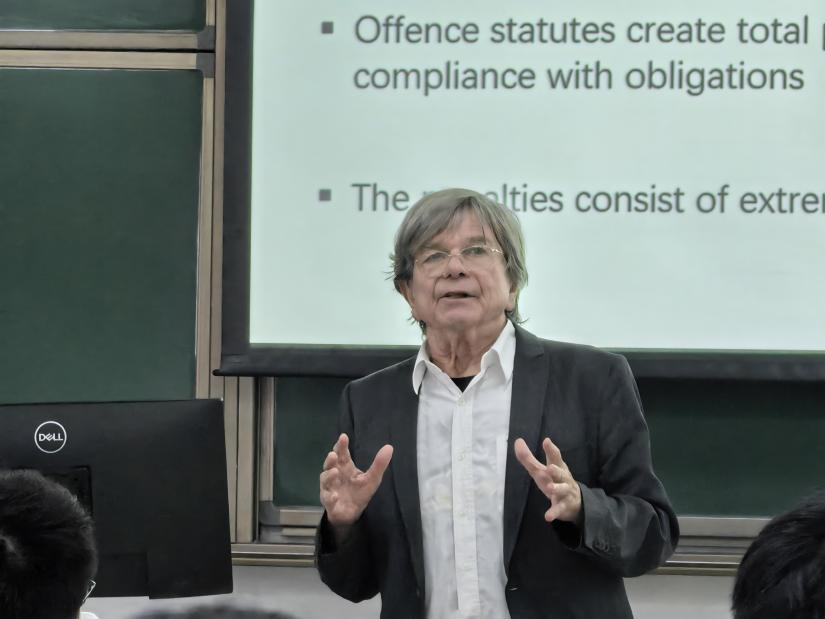
To commence the lecture, Professor Albrecht drew upon the latest definitions from the Organisation for Economic Co-operation and Development (OECD) and the "Council of Europe Framework Convention on Artificial Intelligence" to conceptualize "artificial intelligence." Under this framework, AI is defined as a machine-based system capable of generating predictions, recommendations, or decisions based on input data, thereby influencing physical or virtual environments with varying degrees of autonomy and adaptability. Professor Albrecht subsequently traced the evolutionary trajectory of AI technology, highlighting how advancements in information technology, shifts in data acquisition methodologies, and the advent of the "big data" era have collectively catalyzed the rapid proliferation of intelligent systems.
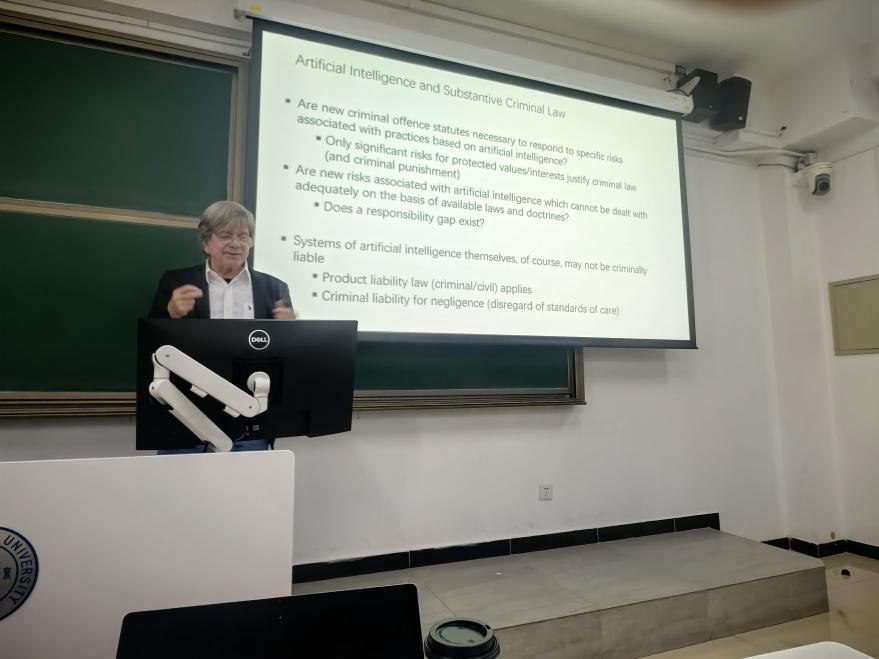
Centering his discourse on two pivotal questions—whether criminal law requires adjustment to address AI-specific risks, and how AI can and should serve criminal justice practice—Professor Albrecht articulated his perspectives with clarity. In the realm of substantive criminal law, he posited that criminal law intervention is justified only when artificial intelligence poses a significant threat to protected legal interests. Citing autonomous vehicles as a case study, he illustrated how Germany effectively bridged the gap between product liability and negligence through amendments to the "Road Traffic Act," thereby averting a "liability vacuum." Regarding criminal justice practice, the professor detailed the extensive application and potential of AI in fraud prevention, predictive policing, and the risk assessment of dangerous offenders. However, while acknowledging the opportunities AI presents for the rule of law, he explicitly warned of associated challenges, including algorithmic discrimination, fairness concerns, and data protection issues, emphasizing the necessity of a comprehensive legal framework for regulation.
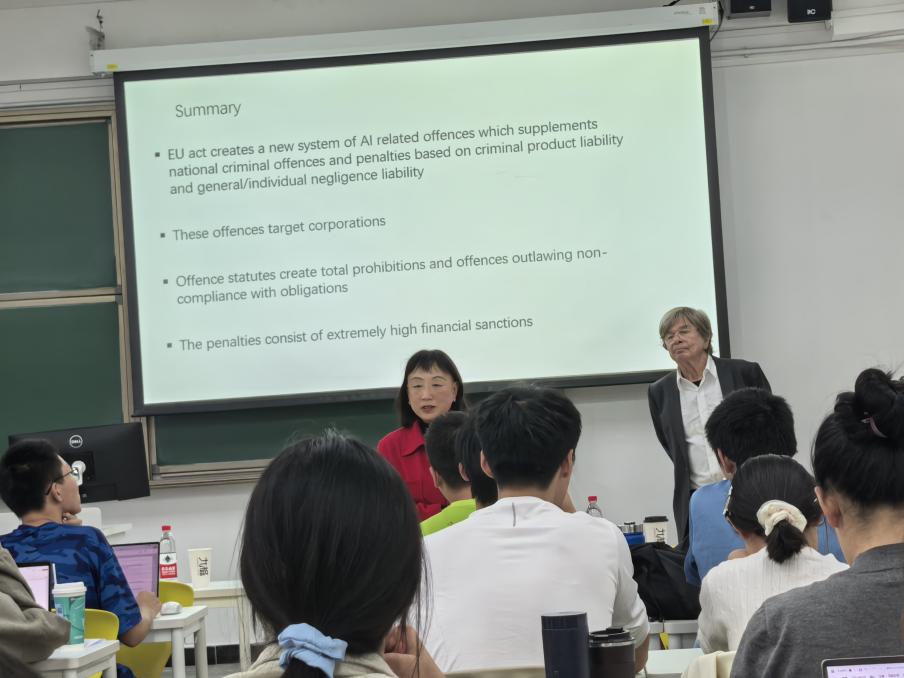
A focal point of the lecture was the "EU Artificial Intelligence Act," the world's first comprehensive legal instrument regulating AI. Professor Albrecht explained that the Act establishes a risk-based tiered regulatory system, categorizing AI systems into four levels: "unacceptable risk," "high risk," "limited risk," and "minimal risk." It imposes stringent legal and compliance obligations on high-risk systems, including mandatory risk assessments, transparency requirements, and market surveillance mechanisms. Regarding liability, the EU framework identifies corporations as the primary responsible entities, backed by substantial administrative fines and specific criminal liability regimes within member states' laws. This creates a dual framework of "EU unified regulation and member state responsibility linkage." Professor Albrecht noted that the Act signifies the institutionalization of AI governance; its innovative regulatory model not only challenges the adaptability of existing criminal law systems but also offers critical insights for nations striving to balance technological innovation with the rule of law.
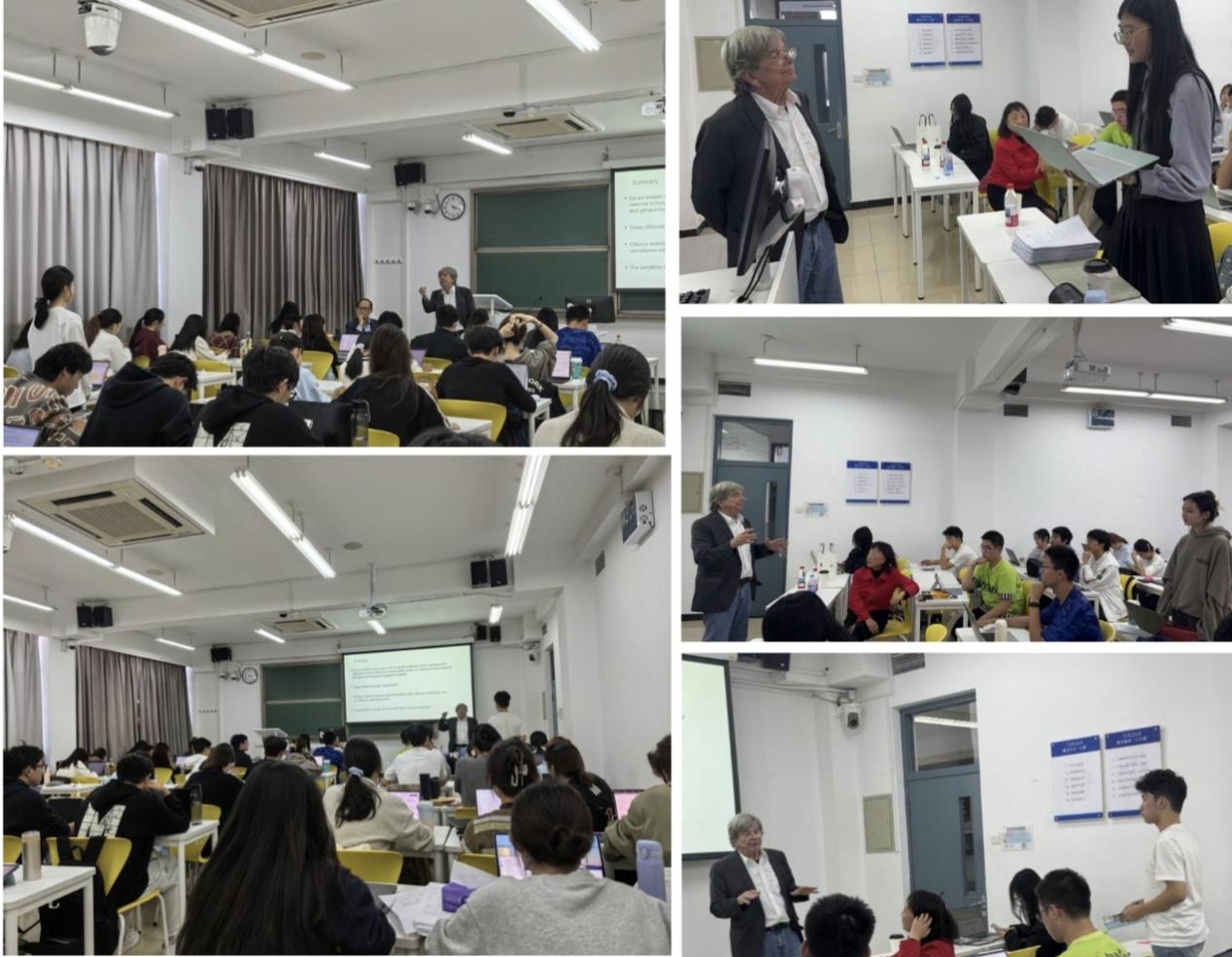
Following the presentation, the session transitioned into an interactive forum characterized by active student participation. Students expressed their gratitude for the inspiring report and posed diverse questions at the intersection of AI and criminal law. These inquiries ranged from theoretical considerations, such as the impact of unpredictable AI decision-making on traditional causal attribution and responsibility allocation, to comparative reflections on China's legislative practices versus the "EU Artificial Intelligence Act." Additionally, some students sought clarification on the determination of legal facts in accident scenarios involving AI. Professor Albrecht provided patient and detailed responses to each query. Subsequently, Professor Yue Liling from the China University of Political Science and Law delivered an insightful commentary on the report.
After the interactive session, this profound and enlightening criminal law class came to a successful conclusion. Students and faculty members took photos with Professor Albrecht. This course not only opened a window to the forefront of academia for the students but also became a precious and beautiful memory on their journey of exploring law.

Contributed by: Song Wenfei