

On December 17, the 125th installment of the BNU Distinguished Jurist Lecture Series, themed “Comparative Empirical Research on Lease Law,” was successfully held in the Gao Mingxuan Lecture Hall (Room 1822) at Beijing Normal University. The lecture was delivered by Professor Zhang Yongjian, the Clarke Chair Professor at Cornell Law School, with Professor Xia Yang of the BNU Law School serving as the moderator. Professors Zhao Jun and Assistant Professor Yang Xu from the Law School served as panelists.
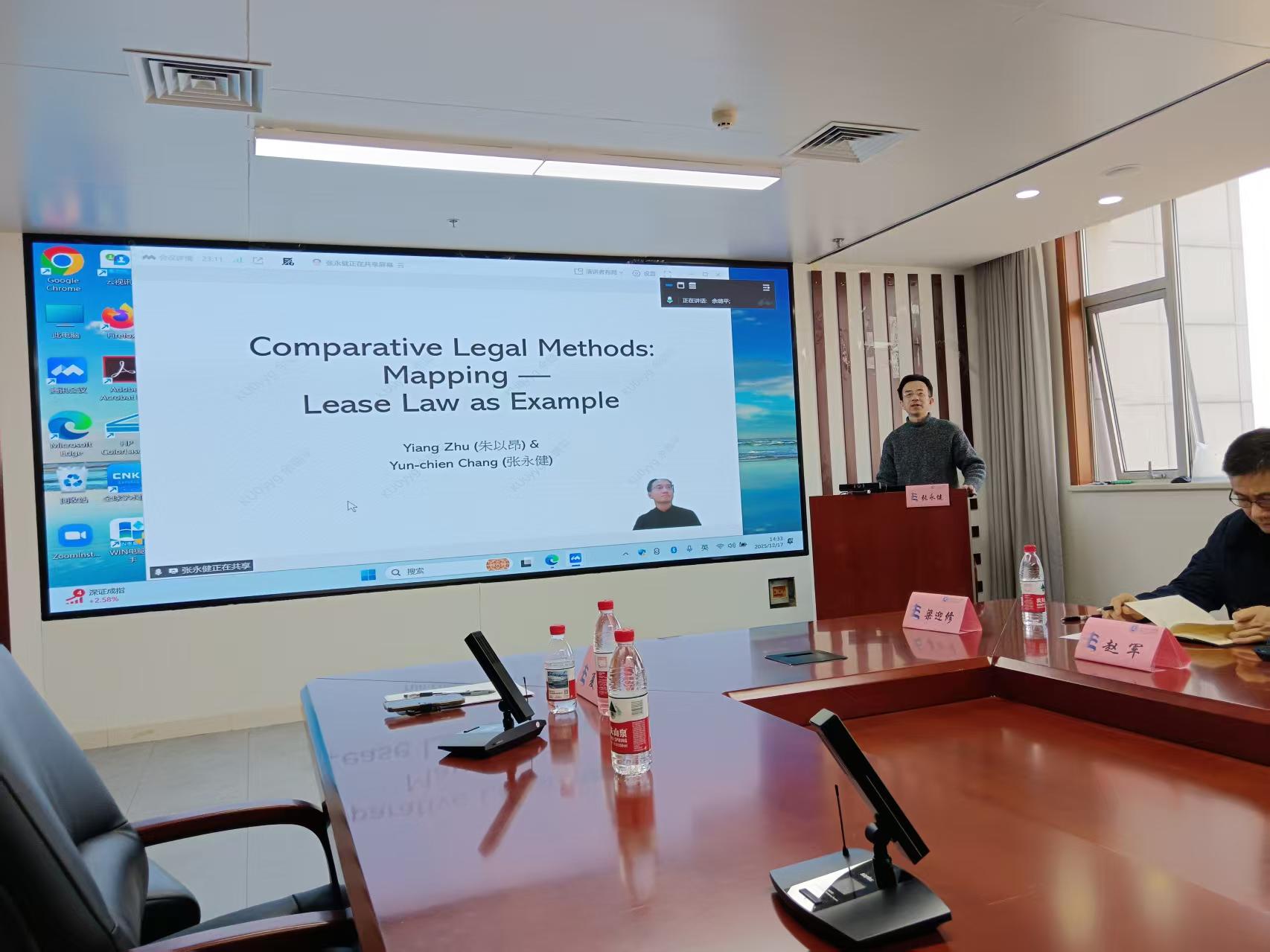
Professor Xia Yang opened the event by extending a warm welcome to Professor Zhang Yongjian and providing a brief introduction to his distinguished academic achievements.
Centered on the theme of “Comparative Empirical Research on Lease Law,” the presentation featured insights from Professor Zhang Yongjian and Dr. Zhu Yi'ang, who have conducted extensive field research on housing rentals in New York’s Chinatown. They utilized map visualization to illustrate the divergences in legal approaches to rental issues across different jurisdictions. Professor Zhang’s lecture primarily focused on three key areas: the landlord’s obligation to ensure property habitability, the tenant’s right to sublet, and the principle that a sale does not terminate a lease (often referred to as "sale breaks no lease").
During the discussion segment, Assistant Professor Yang Xu raised questions regarding the sequence of empirical and comparative research. Professor Zhao Jun questioned the translation of the term “empirical research,” highlighting its association with positivism and noting the difficulty in fully encompassing humanistic inquiries, such as field research, under this label.
Professor Zhang Yongjian and Dr. Zhu Yi'ang provided insightful responses to the points raised by the discussants. In the subsequent Q&A session, faculty and students actively participated, and Professor Zhang offered detailed responses to their inquiries.
To conclude, Professor Xia Yang expressed his gratitude to Professor Zhang Yongjian for his insightful lecture and to the panelists for their contributions. The seminar ended successfully amidst warm applause from the attending faculty and students.