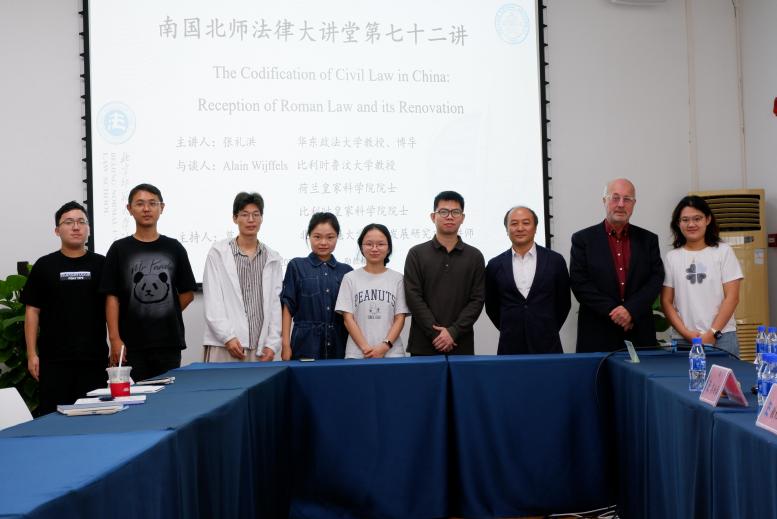
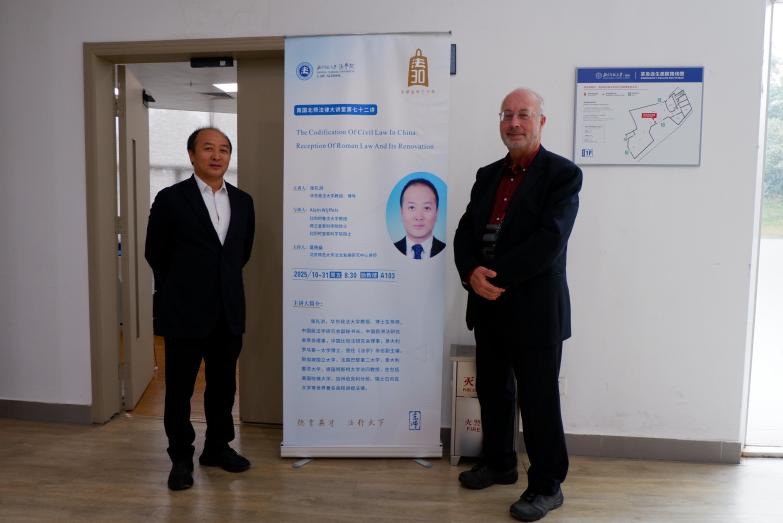
On October 31, 2025, the 72nd lecture of the BNU Zhuhai Legal Lecture Series, titled “The Codification of the Civil Code of China: The Reception and Innovation of Roman Law,” was successfully held in Meeting Room A103 of the Lijiao Building at the Zhuhai Campus of Beijing Normal University. The lecture was delivered by Professor Zhang Lihong, a doctoral supervisor at East China University of Political Science and Law, with Professor Alain Wijffels of KU Leuven, a member of both the Royal Netherlands Academy of Arts and Sciences and the Royal Academy of Belgium, serving as the panelist. The event was hosted by Lecturer Mo Yangshen from the Center on the Rule of Law and Development at Beijing Normal University.

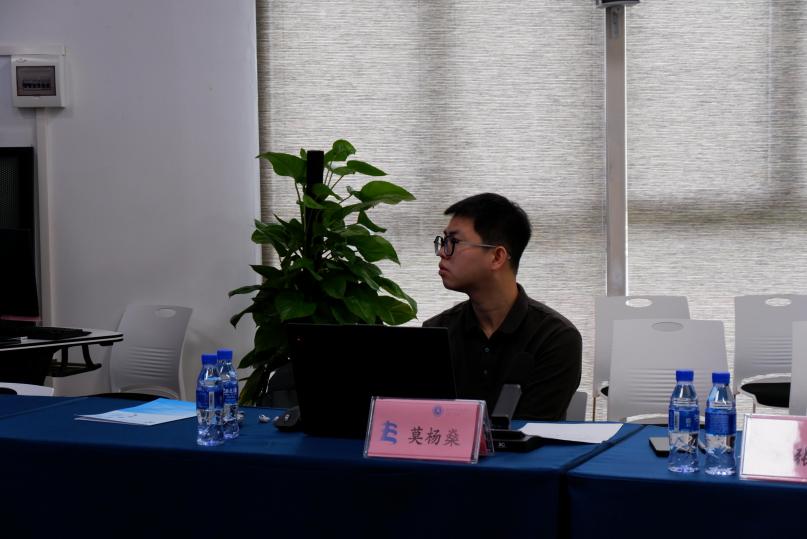
At the beginning of the lecture, Lecturer Mo Yangshen introduced the outstanding academic status and fruitful academic achievements of Professor Zhang Lihong to the attending faculty and students.
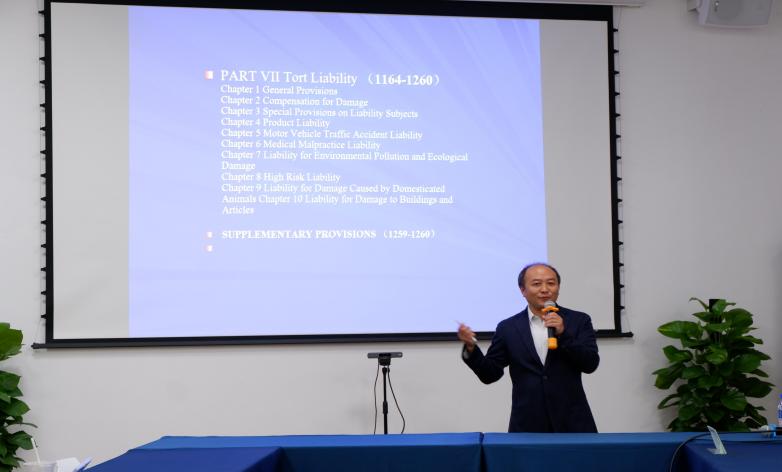
In the lecture, Professor Zhang Lihong systematically elaborated on the development context, institutional characteristics of the Civil Code of China, and its profound origins with Roman law. He pointed out that the Civil Code of China did not emerge out of thin air, but rather underwent a long process of legal reception and localization, absorbing the essence of the Roman law system represented by German law, while fully integrating traditional Confucian thought and socialist core values.
Professor Zhang Lihong particularly emphasized the innovative features of the Civil Code of China: first, it clearly establishes socialist core values as the basis for judicial practice; second, it introduces the "Green Principle" that embodies the concept of ecological civilization; third, it establishes unique systems such as the "Bequest and Support Agreement" and "No-Fault Compensation," showcasing the innovative wisdom of the rule of law system with Chinese characteristics.
During the discussion session, Professor Alain Wijffels offered insightful perspectives from a comparative law standpoint. He observed that the compilation of China's Civil Code not only inherits the profound traditions of Roman law but, more importantly, undergoes a systematic reconstruction through the lens of German jurisprudence. He pointed out that this demonstrates China's selective absorption and innovative development of Western legal traditions on its path toward the modernization of the rule of law.

During the interactive session, student Huo Huairong asked Professor Zhang Lihong about the "unique compensation principle in the Chinese Civil Code." Professor Zhang elaborated on the profound connotation of the "no-fault compensation" principle, explaining that this institutional innovation, rooted in Confucian tradition, requires the economically advantaged party to bear compensation obligations under certain circumstances, even in the absence of legal fault. He emphasized that this is not traditional tort liability but a legal design based on "moral justice and social fairness," reflecting the Confucian view of the state as a "big family" that prioritizes mutual assistance among its members. While this highly distinctive legal concept may lack a precise equivalent in comparative law, it has been widely applied in judicial practice, serving as a vivid example of China's integration of traditional legal culture with the modern spirit of the rule of law.

The lecture provided a deep exploration of the historical origins, institutional innovations, and theoretical significance of the Chinese Civil Code, offering attendees a high-level academic feast and a fresh theoretical perspective for understanding the socialist rule of law system with Chinese characteristics. Faculty and students in attendance expressed that the session not only deepened their understanding of the Chinese Civil Code but also provided profound insight into the unique path and contemporary value of China’s rule of law development.